
Sunday, February 6, 2011


Saturday, February 5, 2011

Friday, February 4, 2011

Thursday, February 3, 2011

Tuesday, March 30, 2010
YUSUF PATHAN: the demolisher
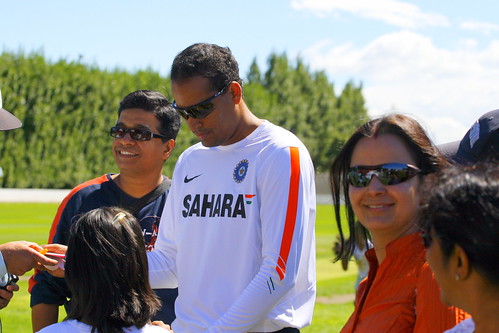
Minimally distracted by mental demons, a man who swings his own brand of willow, Yusuf Khan Pathan is one of the smoothest strokers of a sixer one would ever wish to never bowl to. His bat swing is one of languid violence – if he were not a cricketer, he would have been a shoo-in for the job of fanning an executioner. He has deceptive might and would give brute forcers a key lesson in making healthy contact with the ball. Arguably a better all-rounder than his younger sibling, Irfan, Yusuf can not only hit a longer ball, but on current form, is a more reliable bowling option as well. With his flat drifters, he does not turn the ball a mile, but manages to squeeze the odd delivery through amid a series of dot balls.
Yusuf Pathan began his demolition derby in 1999-2000 when he played for the Baroda Under-16 team in the Vijay Merchant Trophy. A decent bits-and-pieces player from the outset, he walked into the Under-19 sides of Baroda and later, West Zone. Although he made his First-class debut in 2001-02, he began to truly shine during the 2004-05 Ranji Trophy season where he turned out among West Zone’s highest run-scorers and wicket-takers.
Having impressed selectors with his performances in 2007 Inter-state T20 competition, he was included in the Indian squad for the T20 World Cup in South Africa. His International debut did not afford him any immediate extravagant glory. Filling in for the injured Virender Sehwag, he played as an opener in the final against Pakistan at Johannesburg. He heralded his arrival with a lofted skier that cleared the ropes straight down the ground. In terms of tangible contribution, his 15 runs of 8 balls, a solitary over that went for five runs, and one catch did not make for ostentatious news. But in the context of the T20 Final, his start provided India the impetus and his tidy over put the brakes on a rampaging Pakistani run-rate.
His stunning antics for Rajasthan Royals in the 2008 Indian Premier League’s inaugural season made it prudish for the selectors to ignore him any longer and he was drafted into the One Day International side for the Kitply Cup. His first ODI, against Pakistan, was of poor showing, as he struggled to time the ball all through a strained innings. Although played in every game of that series and the next, his performances were lukewarm, and he was dropped from the side. But a Yusuf Pathan relegated to the domestic circuit is a shark in a fish pond, and he soon resumed duty in the Indian side for the England home ODI series a few months later. Here he would start to find himself, carving a niche as a belligerent match-winner, scoring a whirlwind fifty at Indore on his 26th birthday.
In a short span, he became ensconced in the Indian ODI line-up for a while, losing his all-rounder spot only in late 2009 to Ravindra Jadeja. Viewed as a flexible all-rounder who can bat anywhere in the order as per the team’s need to accelerate the run rate, Pathan remains an integral part of MS Dhoni’s T20 team. His bowling too fits in well as he bowls his quota of flat off-breaks at a fair clip, conceding few as the batting side are left to wonder where his overs went. However, he is still viewed as a bit too mercurial, and this has kept him on the sidelines of the ODI team and out of the Test side till now.
In the Deodhar Trophy final, he almost got North Zone over the line blasting an impeccable 39-ball 80. This was the latest in the sequence of high-calibre hitting he had displayed during the 2010 domestic season. Earlier in the season, playing the Duleep Trophy final against South Zone, he followed a first innings century (108) with an unbeaten double ton (210 off 190 balls) in the second innings to lead West Zone to a record-setting highest successful run chase in the history of first class cricket.
Incredible when he enters his zone, he has frequently proven a match-winner for the Rajasthan Royals. At times, he has single-handedly demolished the opposition’s chances with his uncanny hitting. The Royals have faced situations where he has been the only batsman a force to reckon with in the line-up. In IPL 3, he has landed the covetable brand of Most Valued Player, according to the newspaper Rediff. For the price he was bought (USD 475,000), his returns have been disproportionately advantageous. The 37 ball century he wove against the Mumbai Indians became the first century of tournament, and included a record 11 consecutive hits to the boundary, five of which cleared it on the full.
A batsman who seems to be on a campaign to have the authorities see the futility of boundary ropes, Yusuf Pathan appears to play his cricket in zero gravity. Boundary ropes are redundancies for him, and in the manner of Arjuna’s eye, the only target worth his attention seems the top of the stadium roof. He seldom miscues a shot he has decided to loft on the full. His mind does not allow him to ever settle for a grounded shot if the ball is in the zone. His principle seems to be that a ball lofted is a sixer, while a ball played along the ground can only ever be a four at best.
Thursday, March 25, 2010
IPL: CRICKET'S FRIEND OR FOE?

The Indian Premier League has been a manna for many unheralded cricketers, Indian and International. The Pandeys, Bislas, Ojhas, Marshes and Yusuf Pathans were given an occasion to which they could rise, and make their presence felt amongst the bigger names. Inequalities have been bridged, and identities forged. It has done real good for the game of Twenty-twenty and for various entities whose fortunes are intermingled with that of the IPL’s. It has taken cricket to the furthest reaches of the globe and rendered many financially secure(even post retirement). It has also, to some extent, elevated cricket itself, by making it more affable, human and contemporary. But as with anything momentous and money-minded, it has come with its uglier flypside.
The wicket has turned sticky, rubbed with the green. The capitalists have stormed onto the cricket pitch, knocking over the altruists of the game abrasively to the ground. The manner in which the Indian Premier League has laid siege to the game of cricket could evoke images of brash, intoxicated invaders riding their stallions into a captive nation. The game has been packaged and bedecked to draw in the most lucre possible. Commerce has mildly usurped the game and it may actually shrink the classical sport. While fast-paced sports like Baseball or Soccer are great in their own right, when speed-wheels and bowties are added to a venerable game like Cricket, it feels like a devaluation on some levels.
Cricketarian souls have been captured by the promise of thrills and money. Money has once again shown itself to be the one interest the young, the old, and the middle-aged have in common. Then there is the unfortunate upshot when the call to untold riches might make a player cut short his International career to prolong his body and fortune under the employ of Lalit Modi’s brainchild, as has happened with Andrew Flintoff, or (debatably) with Andrew Symonds.
The game is built up as a spectacle, almost a gladiatorial extravaganza, with the sport losing all delusions of being an interest in itself, other than a product presented upon a retailer’s shelf. A clear delineation between the presenters of the package and the purchasing spectators is seen in the booming introductions made by the sacred umpires themselves, serenading the stadium’s crowd with a reverberating “Are you ready, Bangalore?” at the start of the match with the cadence of an announcer at a boxing bout.
The Twenty-twenty format is not so devoid of cricketing subtleties that it would need to be sold by dancing cheerleaders and resplendent glamour. The attempt to build it up as a world-class event has tended to get a touch overwrought, threatening to overly play up the non-cricket aspects in trying to rope in the laziest of the masses. International exposure and celebrity the IPL may well possess, but redundancy always seemed an inevitability with games packed in like a sweaty box of sardines, each match demanding a fresh independent pertinence in the crowded schedule. Blasé exaggerations woven to inject energy into an otherwise homogenous sequence of matches weaken the game’s authenticity. So much money being involved almost holds success hostage, and the feverish urge to pump up the atmosphere is blatantly visible in the manner of many a mid-innings anchor.
The lure has not spared even the staunchest of cricket’s devotees – the venerated Oracle of the sport: the Commentator. The hitherto articulate commentary of someone like Danny Morrison has degenerated into a series of expressive grunts and onomatopoeic outbursts. Even Harsha Bhogle, whose cricketing integrity has always been his immutable claim to the commentator’s box, has succumbed to dishing out the menial phrases of all those under the IPL payroll. Calling a heart-stopping Sixer a DLF Maximum would sound pathetic to anyone who is individualistic enough to be acutely aware of how shamelessly solicitous advertising can get. Screaming it in a tone that brooks no argument, as though a ‘DLF Maximum’ is the most apt and ubiquitous way to describe a ball that clears the ropes is an even greater aspersion cast on the viewer’s individualism. Sixers did exist before the DLF company’s owners even started playing with Lego building blocks, after all...
Phrases like Karbonn Kamal catches and City Moments of Success are marketted almost too regularly to avoid sounding contrived and manipulative. At times the usages have bordered on the ridiculous. A curious incident saw a ‘Karbonn Kamal catch’ reported missed by a butter-fingered member of the crowd, when a ‘DLF maximum’ had been achieved – and therefore it was a ‘City Moment of Success’. Surely a self-respecting watcher of cricket may well take umbrage at being force-fed labels that brazenly.
Once in a while though, a truly incredible feat overshadows the promotional imperative, driving it away momentarily from the commentator’s memory. When AB de Villiers’ pulled off a shocker of a catch on the boundary against the Royal Challengers Bangalore team, Mike Haysman’s benumbed brain forgot that he had been paid to repeat ‘Karbonn Kamal’ whenever justifiable, and he reverted to the more heartfelt ‘goodness gracious!.. Extraordinary...one of the finest catches you will ever see!” before duty was remembered.
For all the pejorative connotations held by the word ‘shrewd’, IPL’s think-tank – predominantly Lalit Modi – has only really tapped the public’s most lucrative interest. Modi has brought them their breakfast in bed, served upon a pampering tray of frills and thrills. Wynand-esque in its philosophy, the IPL synergises the elements that attract visceral interest in the public, and gathers them into a package that is irresistible despite a certain dilution of cricket by what extreme traditionalists might deem commercial depravity. If the IPL were a girlfriend, she would be quite a Karbonn Kamal.
Monday, February 22, 2010
NO FAIR: IT'S NOT CRICKET
Maybe I'm the one that's paranoid. Maybe the Indian team has genuinely become the kind of side that can take a hit and come back aggressive as you please, psyching the opposition against all odds. I am also one of the billion-plus people who would like to believe that. But I also like to feel like I have an "x-ray" sense, if you will, that sensitizes me to the subliminal energy levels of the Indian team. At the times when this energy level matches what I see on TV, I am able to believe that the Indian side has fared according to its performance. But several times, more so off late, I can't help but feel that Indian cricket has been suctioned by a politicized world.
What do I mean by that? The game of cricket has grown such a viewership and patronage that it presents itself as the perfect mascot for politicos to channel their agendas through. It would indeed seem unnatural if such a media specimen as ostentatious as the Indian cricket team were not exploited by the powers that be. In a certain liberal sense, such exploitation would not even seem wrong or immoral. A sport need not ever feel like it supersedes a self-promoting agenda. A businessman may surely use something as attention-grabbing as the Indian cricket side to help his agenda along – no incriminations leveled. Fair enough. But it does hurt the ardent follower of the game to feel that the game they are investing so much of their energies and passion on could be rigged.
(The following is seeped in conjecture that I would like to be read with an open mind – indeed with a mind wanting to be led by the words it is reading)
Let us hark back a couple of years, where I first perceived this phenomenon in operation, to the T20 World Cup in South Africa. It can't be too outrageous an accusation to say that the Indian World T20 Champion squad possessed neither the mightiest hitters nor the most balanced T20 team. Indeed bowlers like Sreesanth, RP Singh were never touted as run-scrunchers. Even to this day, I can't help but wonder how India won the tournament playing against teams that boasted relentless hitters like Hayden, Gilchrist, Gayle, Graeme Smith, Mccullum and others. This is not to detract from the intense, timely performances by Indian players, but try as I might, I can't imagine how the Australian team performed worse on the same wicket that the Indians batted on. Emerging stars and fiery competitors in the oppositions apart, Australia cannot have been as feeble as they appeared to be during that tournament.
That was the period in cricketing history when a nascent format cried for feeding. Twenty-Twenty is largely a commerce-driven sport, as indeed it caters to the masses. The Men in charge of cricket's future (I don't know for sure who these are, but there have to be them) probably saw this as a most lucrative avenue. As they scratched their bearded chins (again, I can't make any informed assessment regarding the fuzziness of their chins, but let's assume for effect), the oldest member tugged his goatee especially hard and came up with the glorious realisation that India was the melting pot of cricketing dough. What better people to comprise a viewership than the largest and most proudly passionate cricket-fanatics in the world?
The tournament’s Final was aptly scripted to showcase the ripest rivalry cricket has been blessed with – India vs. Pakistan. And as India won the T20 World Cup, the senile (or youthful, I don't know!) wise men of cricket slapped each other high fives for the successful enticement of a billion wallets.
Then the next avatar taken by the Round Table of Cricket Elders: the T20 World Cup 2009. Pakistan had been through trying times at the time, and the refreshing quality of the timely victory to the despondent nation was beset, in my mind, by the same artificial phenomenon I saw repeated. Mohammad Aameer had bowled a wicket-maiden in the first over of a T20 World Cup Final to the fearsome Dilshan, and something felt amiss.
Not that either India or Pakistan is the best team in the world in the shorter format. Indeed, several pundits will tell you that neither has the normative ingredients that make up a champion team. The volatile and short format probably made it easier by making it necessary to win only a few matches; or on the flipside, be knocked out just as easily. It feels like an untrustworthily spoon-fed case-in-point in favour of my argument, but the first two winners of T20 tournaments just happened to be the two most ardent cricketing nations.
(Thanks for coming along and holding onto your rocks and tomatoes for this long. I pray for a slight increase in broadmindedness for the following words)
Now when Test cricket faced brickbats in the face of fast emptying stands, and needed a boost to stay alive, the best thing to happen to the form that needed saving was an India-based rescuing of the damsel in distress. The ever vigilant universe saw to it that India found itself at the top of the Test-rankings and the media fell in step with much expedient sensationalizing of this event. The next act of God was that the schedule did not hold any matches for India for a while. This made for more fodder for the media in that the Indian season's final Test series against South Africa could be touted grandly as the World Championship of Cricket.
The first Test at Nagpur India lost miserably. An innings defeat is hard to bear for a Numero Uno team. How much this defeat would benefit the cause of the sensationalist media in the slightly longer run is evident now. The next match at the Eden Gardens was a must-win for India to retain its youthful berth at the top for the end of the season. India rallied mightily, delivering a like blow to the Proteas to clinch a penultimate-over victory. Harbhajan Singh duly performed his historic sprint evading clamouring teammates, making a beeline for the boundary ropes, where his Athenian exultations may be all the better displayed in the limelight. The sight of a triumphant Bhajji throwing open his chest at the roaring crowd in a feral expression of victory has to be a genuinely powerful image in sporting history books.
All this constituted a strong shot in the arm for Test cricket. Now that India is the top ranked team in a format, there is bound to be healthy respect for Test cricket, which as always Indian glory never fails to generate for its patron format.
With such glorious goals as to preserve the sport and do some Samaritanism for an ailing nation; even promote a young sport, the artifices of cricket’s powers can well be condoned. Even praised. But what price an honest game of cricket?
Here is me hoping to be trashed with convincing counter-arguments debunking all this as paranoid, irrational mental gymnastics. But watching India play has lost that much sheen for me as every time I watch them play, the puppet strings stand out from their shoulder-blades.
What do I mean by that? The game of cricket has grown such a viewership and patronage that it presents itself as the perfect mascot for politicos to channel their agendas through. It would indeed seem unnatural if such a media specimen as ostentatious as the Indian cricket team were not exploited by the powers that be. In a certain liberal sense, such exploitation would not even seem wrong or immoral. A sport need not ever feel like it supersedes a self-promoting agenda. A businessman may surely use something as attention-grabbing as the Indian cricket side to help his agenda along – no incriminations leveled. Fair enough. But it does hurt the ardent follower of the game to feel that the game they are investing so much of their energies and passion on could be rigged.
(The following is seeped in conjecture that I would like to be read with an open mind – indeed with a mind wanting to be led by the words it is reading)
Let us hark back a couple of years, where I first perceived this phenomenon in operation, to the T20 World Cup in South Africa. It can't be too outrageous an accusation to say that the Indian World T20 Champion squad possessed neither the mightiest hitters nor the most balanced T20 team. Indeed bowlers like Sreesanth, RP Singh were never touted as run-scrunchers. Even to this day, I can't help but wonder how India won the tournament playing against teams that boasted relentless hitters like Hayden, Gilchrist, Gayle, Graeme Smith, Mccullum and others. This is not to detract from the intense, timely performances by Indian players, but try as I might, I can't imagine how the Australian team performed worse on the same wicket that the Indians batted on. Emerging stars and fiery competitors in the oppositions apart, Australia cannot have been as feeble as they appeared to be during that tournament.
That was the period in cricketing history when a nascent format cried for feeding. Twenty-Twenty is largely a commerce-driven sport, as indeed it caters to the masses. The Men in charge of cricket's future (I don't know for sure who these are, but there have to be them) probably saw this as a most lucrative avenue. As they scratched their bearded chins (again, I can't make any informed assessment regarding the fuzziness of their chins, but let's assume for effect), the oldest member tugged his goatee especially hard and came up with the glorious realisation that India was the melting pot of cricketing dough. What better people to comprise a viewership than the largest and most proudly passionate cricket-fanatics in the world?
The tournament’s Final was aptly scripted to showcase the ripest rivalry cricket has been blessed with – India vs. Pakistan. And as India won the T20 World Cup, the senile (or youthful, I don't know!) wise men of cricket slapped each other high fives for the successful enticement of a billion wallets.
Then the next avatar taken by the Round Table of Cricket Elders: the T20 World Cup 2009. Pakistan had been through trying times at the time, and the refreshing quality of the timely victory to the despondent nation was beset, in my mind, by the same artificial phenomenon I saw repeated. Mohammad Aameer had bowled a wicket-maiden in the first over of a T20 World Cup Final to the fearsome Dilshan, and something felt amiss.
Not that either India or Pakistan is the best team in the world in the shorter format. Indeed, several pundits will tell you that neither has the normative ingredients that make up a champion team. The volatile and short format probably made it easier by making it necessary to win only a few matches; or on the flipside, be knocked out just as easily. It feels like an untrustworthily spoon-fed case-in-point in favour of my argument, but the first two winners of T20 tournaments just happened to be the two most ardent cricketing nations.
(Thanks for coming along and holding onto your rocks and tomatoes for this long. I pray for a slight increase in broadmindedness for the following words)
Now when Test cricket faced brickbats in the face of fast emptying stands, and needed a boost to stay alive, the best thing to happen to the form that needed saving was an India-based rescuing of the damsel in distress. The ever vigilant universe saw to it that India found itself at the top of the Test-rankings and the media fell in step with much expedient sensationalizing of this event. The next act of God was that the schedule did not hold any matches for India for a while. This made for more fodder for the media in that the Indian season's final Test series against South Africa could be touted grandly as the World Championship of Cricket.
The first Test at Nagpur India lost miserably. An innings defeat is hard to bear for a Numero Uno team. How much this defeat would benefit the cause of the sensationalist media in the slightly longer run is evident now. The next match at the Eden Gardens was a must-win for India to retain its youthful berth at the top for the end of the season. India rallied mightily, delivering a like blow to the Proteas to clinch a penultimate-over victory. Harbhajan Singh duly performed his historic sprint evading clamouring teammates, making a beeline for the boundary ropes, where his Athenian exultations may be all the better displayed in the limelight. The sight of a triumphant Bhajji throwing open his chest at the roaring crowd in a feral expression of victory has to be a genuinely powerful image in sporting history books.
All this constituted a strong shot in the arm for Test cricket. Now that India is the top ranked team in a format, there is bound to be healthy respect for Test cricket, which as always Indian glory never fails to generate for its patron format.
With such glorious goals as to preserve the sport and do some Samaritanism for an ailing nation; even promote a young sport, the artifices of cricket’s powers can well be condoned. Even praised. But what price an honest game of cricket?
Here is me hoping to be trashed with convincing counter-arguments debunking all this as paranoid, irrational mental gymnastics. But watching India play has lost that much sheen for me as every time I watch them play, the puppet strings stand out from their shoulder-blades.
Friday, December 25, 2009
THE CRAFT OF REVIEWING THE ARTS
Writing on the Performing Arts is prone to be a tricky activity. The writer is ever torn between tackling the sensibilities of a diverse readership whilst bearing the burden of having to give an objective account of a performance. Essentially a process of translating a largely subjective enterprise into a commercialized product, it bears the risk of tainting or distorting the simulacrum.
Besides, it seems a tough prospect for a writer of the Arts not to allow the writing to spiral into a splish-splash of colourful adjectives and hollow, interchangeable phrases. It sometimes seems as though the writer is trying to compete with the singer themselves in bringing out equally charming creativity. They tend to sound very mesmerizing, but quite often a phrase seems overburdened with inapt synonyms dredged up from a thesaurus. Often the writer may be tempted to write on music as though they were doing a 5th grade prose writing assignment – full of poetic platitudes and verbal exuberance. While it is fair to assume that the writer hopes to drench the piece in the atmosphere that the performance created in the auditorium, when one writes in that nebulous way, it sometimes sounds unrelatable.
For instance, SVK writes in his December 22 piece titled ‘In a reflective mood’ about Bombay Jayasri – “Her gentle, elegant voice blended seamlessly with melodic harmony, creating an amicable aura.” It is commonly known that harmony is the distinct opposite of melody, so this phrase sounds like an attempt to juxtapose contradictions to create and avail of a resulting shock value. Another phrase ran – “She used silences between sancharas and cadences in the tara sthayi to make the raga a rhapsody of sound.” This is ambiguous in that it asserts that silence added to the total sum of sound in the performance. It is hard to ascertain whether this is a poor use of language, or whether the author referred to an actual, tangible phenomenon.
At times, the writer also tends to forget that the reader might not appreciate being patronized by being force-fed a certain opinion as gospel. The readers of music and art reviews in themselves tend to be quite proud of their personal judgements, and would resent the absoluteness of a statement that contradicts their opinion. For instance, on December 25, G.Swaminathan writes on Sikkil Gurucharan’s performance, “With his pliable and attractive voice in good control, Gurucharan mesmerized the audience with his delineations of a rare kriti.” Such a statement might well evoke complaints such as “speak for yourself!” Also the reader might object to being collectively bunched as ‘the audience’ like a pack of sardines.
Furthermore, polarized pronouncements such as those cannot do much in the way of conveying the performance to someone who had not been present for the programme.
“Kalyani normally stimulates the artist to go for fast paced brigas and akaras than finer karvais and loaded pauses. But Gurucharan comprehending the potential of the great Kalyani, utilized his vocal prowess to bring the best encompassing both ragas and brigas.” This stands as a classic example of verbosity detracting from the otherwise valuable point. While the writer sensibly gives a backdrop to the point being made, the mention about the singer’s prowess seems an unnecessarily banal commendation that renders the point a prosaic platitude in the end.
When dance reviews are not saddled with dispensable terms such as ‘footwork’, ‘fluency’ – and other such fixed notions upon which to judge an innovative, expressive art form – but are rather analysed on their representations and articulation of ideas, they tend to work better.
In a refreshingly interesting read, Vidya Saranyan’s piece titled ‘Power-packed presentation’ explores the nuances of Suryanarayana Murthy’s performance based around body language and eye movement. It goes further to unravel the articulations in the dance and the ideas represented in its choreography – “..he distinguished the walk of Rama from the swagger of Manmatha and the story ....with tones of remorse and sorrow, were moments where the dancer sidestepped conventional sringara interpretations in favour of devotion.” This seemed to have a relevant understanding of a reader’s intention of picking up a review to read. It gave the reader an idea of what unfolded in the performance rather than simply condemn it or confer accolades.
In contrast, Rupa Srikanth writes in ‘Fine footwork, vibrant style’ on December 22, “Her [Sailaja] footwork on the whole was clear and precise, except the footwork on the brass plate that left much to be desired.” It can be sensed that the only reason one doesn’t throw up one’s hands and demand to know by whom the performance left much to be desired is because the pronouncement is made by an esteemed connoisseur. The expert’s role could be better played out if they analysed the structure and efficacy of the performance instead of sitting back on the arm-chair and doling out polarized judgements. Not many must read reviews to simply keep track of what the expert opinion is on a certain performer, unless they are interested in the art for the sake of dropping names and borrowed opinions in elite circles.
A polite eavesdrop into the conversation between seasoned rasikas would reveal a myriad aspects of music that a lesser being would struggle to comprehend. Yet, there is the unmistakable air of snobbish cooperation between them wherein each member strives to uphold the credibility of the House of musical aristocrats, and their collective claim to be able to judge a subjective art in an absolutely objective manner. In the end you just have to lay down arms and accept that you might be dealing with a realm which is beyond your comprehension, and thus one which you are not qualified to have critical thoughts about. Maybe this is the very same disabling culmination that the art critic relies on every time they advance an opinion in the public forum.
Besides, it seems a tough prospect for a writer of the Arts not to allow the writing to spiral into a splish-splash of colourful adjectives and hollow, interchangeable phrases. It sometimes seems as though the writer is trying to compete with the singer themselves in bringing out equally charming creativity. They tend to sound very mesmerizing, but quite often a phrase seems overburdened with inapt synonyms dredged up from a thesaurus. Often the writer may be tempted to write on music as though they were doing a 5th grade prose writing assignment – full of poetic platitudes and verbal exuberance. While it is fair to assume that the writer hopes to drench the piece in the atmosphere that the performance created in the auditorium, when one writes in that nebulous way, it sometimes sounds unrelatable.
For instance, SVK writes in his December 22 piece titled ‘In a reflective mood’ about Bombay Jayasri – “Her gentle, elegant voice blended seamlessly with melodic harmony, creating an amicable aura.” It is commonly known that harmony is the distinct opposite of melody, so this phrase sounds like an attempt to juxtapose contradictions to create and avail of a resulting shock value. Another phrase ran – “She used silences between sancharas and cadences in the tara sthayi to make the raga a rhapsody of sound.” This is ambiguous in that it asserts that silence added to the total sum of sound in the performance. It is hard to ascertain whether this is a poor use of language, or whether the author referred to an actual, tangible phenomenon.
At times, the writer also tends to forget that the reader might not appreciate being patronized by being force-fed a certain opinion as gospel. The readers of music and art reviews in themselves tend to be quite proud of their personal judgements, and would resent the absoluteness of a statement that contradicts their opinion. For instance, on December 25, G.Swaminathan writes on Sikkil Gurucharan’s performance, “With his pliable and attractive voice in good control, Gurucharan mesmerized the audience with his delineations of a rare kriti.” Such a statement might well evoke complaints such as “speak for yourself!” Also the reader might object to being collectively bunched as ‘the audience’ like a pack of sardines.
Furthermore, polarized pronouncements such as those cannot do much in the way of conveying the performance to someone who had not been present for the programme.
“Kalyani normally stimulates the artist to go for fast paced brigas and akaras than finer karvais and loaded pauses. But Gurucharan comprehending the potential of the great Kalyani, utilized his vocal prowess to bring the best encompassing both ragas and brigas.” This stands as a classic example of verbosity detracting from the otherwise valuable point. While the writer sensibly gives a backdrop to the point being made, the mention about the singer’s prowess seems an unnecessarily banal commendation that renders the point a prosaic platitude in the end.
When dance reviews are not saddled with dispensable terms such as ‘footwork’, ‘fluency’ – and other such fixed notions upon which to judge an innovative, expressive art form – but are rather analysed on their representations and articulation of ideas, they tend to work better.
In a refreshingly interesting read, Vidya Saranyan’s piece titled ‘Power-packed presentation’ explores the nuances of Suryanarayana Murthy’s performance based around body language and eye movement. It goes further to unravel the articulations in the dance and the ideas represented in its choreography – “..he distinguished the walk of Rama from the swagger of Manmatha and the story ....with tones of remorse and sorrow, were moments where the dancer sidestepped conventional sringara interpretations in favour of devotion.” This seemed to have a relevant understanding of a reader’s intention of picking up a review to read. It gave the reader an idea of what unfolded in the performance rather than simply condemn it or confer accolades.
In contrast, Rupa Srikanth writes in ‘Fine footwork, vibrant style’ on December 22, “Her [Sailaja] footwork on the whole was clear and precise, except the footwork on the brass plate that left much to be desired.” It can be sensed that the only reason one doesn’t throw up one’s hands and demand to know by whom the performance left much to be desired is because the pronouncement is made by an esteemed connoisseur. The expert’s role could be better played out if they analysed the structure and efficacy of the performance instead of sitting back on the arm-chair and doling out polarized judgements. Not many must read reviews to simply keep track of what the expert opinion is on a certain performer, unless they are interested in the art for the sake of dropping names and borrowed opinions in elite circles.
A polite eavesdrop into the conversation between seasoned rasikas would reveal a myriad aspects of music that a lesser being would struggle to comprehend. Yet, there is the unmistakable air of snobbish cooperation between them wherein each member strives to uphold the credibility of the House of musical aristocrats, and their collective claim to be able to judge a subjective art in an absolutely objective manner. In the end you just have to lay down arms and accept that you might be dealing with a realm which is beyond your comprehension, and thus one which you are not qualified to have critical thoughts about. Maybe this is the very same disabling culmination that the art critic relies on every time they advance an opinion in the public forum.
Sunday, December 13, 2009
INDIA SHINE AND RISE TO THE TOP
At long last, Test cricket received a stimulus shot as India clinched the top spot in the ICC Test team rankings for the first time, following its series victory over the visiting Sri Lankan team. Overtaking South Africa, Mahendra Singh Dhoni’s team became the third team, since the Test championship was introduced in 2001, to occupy the coveted spot. This augurs well for the languishing Test Cricket arena. Hard graft, teamwork, balance and discipline are some of the labels attached to this team, which has only come to benefit under the youthful maturity that Dhoni has brought to the table with his serene captaincy.
India can boast one of the most balanced batting and bowling line-ups in today’s teams. The stability of the starts Gambhir and Sehwag construct does not diminish their freedom. Riding on their work, a massive middle order comes to surfeit. Dravid, Tendulkar and Laxman have made sure that Ganguly is not overly missed, with consistent contributions. Yuvraj and Dhoni have hung back at the end to provide the quick runs to take targets out of reach for the opposition.
Tendulkar, resident Grandsire of the Indian One-day outfit, finds time to exult over what must be a long-cherished dream. His Test career has spanned two decades, in which he has played among several Indian greats like Kapil Dev, Srikkanth, Shastri, Azharuddin, Ganguly, Amarnath and more. In all these years, the Indian team was subjected to the labeling of being a “home bully‘- “away bunny”. Finally, Tendulkar can be part of the team which, even though bereft of one of the Fab Four, touched the summit.
Dhoni too graciously acknowledged the entire gamut of contributions by the coach, personnel and whoever had been part of the side in the last 18 months. While this hard-earned achievement is to be celebrated at the moment, it could well be short-lived, as India will not have the chance to protect its new-found title in the coming months. It plays only two tests in the next six months. The next Test India is scheduled to play is against Bangladesh, beyond which there will be a dry spell. During that time, their fate as the top-dog would be vulnerable and defenceless. Dhoni, ever the optimist, decided to play this susceptibility down and asserted that this was a time to savour the remarkable achievement rather than worry about something they could not control. Maintaining this position would be an unsteady prospect, notwithstanding the lack of upcoming matches.
Harsha Bhogle brings attention to the fact that while this achievement is a remarkable one by Dhoni’s team, the cash prize awarded to the current set of players ignores the sizeable contribution that past teams and players have made to this end. Sourav Ganguly built India up to the point where they were no longer pushovers outside their backyard. Under Dravid’s captaincy, the team ended several winless droughts overseas – in West Indies and England. Anil Kumble generated the team discipline that won India the Perth Test in 2008. Therefore, it has been an honest ascent to the top for India, and not a patronized placement as many might like to believe.
Geoff Boycott never fails to strike the dissonant, albeit astute note. In his inimitable wont, he has pointed out that the Test ranking system bears flaws and is unreliable in instating a particular team at the top. He notes that unless there is an equitable distribution of matches with and against each team, a fair judgement cannot be made as regards the best team in the world. Perhaps his famed grandmom could come up with such a system, Haroon Lorgat might offer.

India can boast one of the most balanced batting and bowling line-ups in today’s teams. The stability of the starts Gambhir and Sehwag construct does not diminish their freedom. Riding on their work, a massive middle order comes to surfeit. Dravid, Tendulkar and Laxman have made sure that Ganguly is not overly missed, with consistent contributions. Yuvraj and Dhoni have hung back at the end to provide the quick runs to take targets out of reach for the opposition.
Tendulkar, resident Grandsire of the Indian One-day outfit, finds time to exult over what must be a long-cherished dream. His Test career has spanned two decades, in which he has played among several Indian greats like Kapil Dev, Srikkanth, Shastri, Azharuddin, Ganguly, Amarnath and more. In all these years, the Indian team was subjected to the labeling of being a “home bully‘- “away bunny”. Finally, Tendulkar can be part of the team which, even though bereft of one of the Fab Four, touched the summit.
Dhoni too graciously acknowledged the entire gamut of contributions by the coach, personnel and whoever had been part of the side in the last 18 months. While this hard-earned achievement is to be celebrated at the moment, it could well be short-lived, as India will not have the chance to protect its new-found title in the coming months. It plays only two tests in the next six months. The next Test India is scheduled to play is against Bangladesh, beyond which there will be a dry spell. During that time, their fate as the top-dog would be vulnerable and defenceless. Dhoni, ever the optimist, decided to play this susceptibility down and asserted that this was a time to savour the remarkable achievement rather than worry about something they could not control. Maintaining this position would be an unsteady prospect, notwithstanding the lack of upcoming matches.
Harsha Bhogle brings attention to the fact that while this achievement is a remarkable one by Dhoni’s team, the cash prize awarded to the current set of players ignores the sizeable contribution that past teams and players have made to this end. Sourav Ganguly built India up to the point where they were no longer pushovers outside their backyard. Under Dravid’s captaincy, the team ended several winless droughts overseas – in West Indies and England. Anil Kumble generated the team discipline that won India the Perth Test in 2008. Therefore, it has been an honest ascent to the top for India, and not a patronized placement as many might like to believe.
Geoff Boycott never fails to strike the dissonant, albeit astute note. In his inimitable wont, he has pointed out that the Test ranking system bears flaws and is unreliable in instating a particular team at the top. He notes that unless there is an equitable distribution of matches with and against each team, a fair judgement cannot be made as regards the best team in the world. Perhaps his famed grandmom could come up with such a system, Haroon Lorgat might offer.
Friday, November 27, 2009
BAT AN EYELID AND ANOTHER CENTURY
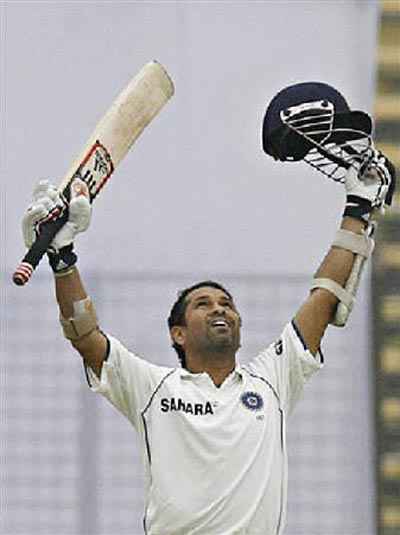 …Well, as it turned out, not only did Sachin successfully save the first Test for India, but he managed to use the occasion to add one more century to his towering stockpile of 87 international centuries – as an afterthought. Does the man have no mercy? Any more moot centuries and the skyscraper might topple over and damage the wicket!
 The last day of the first Test between India and Sri Lanka saw India needing to bat the day out for a draw, with 8 wickets in hand. Mishra – night-watchman for namesake – had just succumbed to a sharp cutter from Matthews. Enter the Maestro.
He looked busy from the start, cutting Matthews to the point boundary and driving Muralitharan against the turn with experienced ease. Building a solid partnership with fellow centurion Gambhir, Tendulkar inched his way closer to his 43rd Test century. Then with VVS Laxman, he carried his bat through till stumps, on the stroke of which he scored his hundredth run of the innings. He also crossed the 30,000 mark somewhere along the line. It was refreshing to see Dhoni and Sangakkara allow Tendulkar the century before calling off the match as a desultory draw.
Give Tendulkar a rampant Aussie team and 50,000 clamouring fans in Sharjah and he will give you a hundred. Give him a dead, even strip such as the one in Kanpur and he would be hard pressed not to score you a century. With Laxman for sedate company, the restful outing he got in the middle seemed the perfect gift from the Cricket Gods to commemorate his strenuous 20 years in international cricket.
What he does not need is the untimely flak he is getting now from Bal Thackeray on what was an absolutely secular comment made by him. Perhaps Thackeray means well. Perhaps he simply wants to use Sachin’s occasion to get some personal leverage. But it is still in bad taste, if you ask me. Even Marathi actors like Atul Kulkarni, Madhur Bhandarkar and Sonali Bendre feel it is a non-issue that is being unnecessarily politicised. Maybe the great man should be allowed to have his achievement untainted.
Meanwhile, Michael Atherton has come out and doused the festivities a bit by drawing attention to the fact that Tendulkar has built his vita opus in the age of helmets and other protective paraphernalia, where the batsman can play without fear of death by leather. He cautions that calling Tendulkar the best ever would be blinding oneself to what the ancient cricketer like Bradman had to negotiate. Sadly this makes it impossible for die-hard cricket enthusiasts to ever declare anyone The Greatest. Technology – ironically something that Tendulkar recently came out denouncing – has struck out at his title. But in Tendulkar’s defence, he has had to contend with something which the great Don did not – bearing the weight of a billion plus hopes upon his spine every time he dons his gloves.
BCCI plans to honour Tendulkar with special mementos during the Annual BCCI Awards Ceremony on December 6. It will be another resonant note in the glorious symphony that is Sachin Tendulkar’s cricket career.
Subscribe to:
Posts (Atom)