
Showing posts with label cricket. Show all posts
Showing posts with label cricket. Show all posts
Thursday, March 3, 2011


Saturday, February 5, 2011

Friday, February 4, 2011

Thursday, February 3, 2011

Thursday, March 25, 2010
IPL: CRICKET'S FRIEND OR FOE?

The Indian Premier League has been a manna for many unheralded cricketers, Indian and International. The Pandeys, Bislas, Ojhas, Marshes and Yusuf Pathans were given an occasion to which they could rise, and make their presence felt amongst the bigger names. Inequalities have been bridged, and identities forged. It has done real good for the game of Twenty-twenty and for various entities whose fortunes are intermingled with that of the IPL’s. It has taken cricket to the furthest reaches of the globe and rendered many financially secure(even post retirement). It has also, to some extent, elevated cricket itself, by making it more affable, human and contemporary. But as with anything momentous and money-minded, it has come with its uglier flypside.
The wicket has turned sticky, rubbed with the green. The capitalists have stormed onto the cricket pitch, knocking over the altruists of the game abrasively to the ground. The manner in which the Indian Premier League has laid siege to the game of cricket could evoke images of brash, intoxicated invaders riding their stallions into a captive nation. The game has been packaged and bedecked to draw in the most lucre possible. Commerce has mildly usurped the game and it may actually shrink the classical sport. While fast-paced sports like Baseball or Soccer are great in their own right, when speed-wheels and bowties are added to a venerable game like Cricket, it feels like a devaluation on some levels.
Cricketarian souls have been captured by the promise of thrills and money. Money has once again shown itself to be the one interest the young, the old, and the middle-aged have in common. Then there is the unfortunate upshot when the call to untold riches might make a player cut short his International career to prolong his body and fortune under the employ of Lalit Modi’s brainchild, as has happened with Andrew Flintoff, or (debatably) with Andrew Symonds.
The game is built up as a spectacle, almost a gladiatorial extravaganza, with the sport losing all delusions of being an interest in itself, other than a product presented upon a retailer’s shelf. A clear delineation between the presenters of the package and the purchasing spectators is seen in the booming introductions made by the sacred umpires themselves, serenading the stadium’s crowd with a reverberating “Are you ready, Bangalore?” at the start of the match with the cadence of an announcer at a boxing bout.
The Twenty-twenty format is not so devoid of cricketing subtleties that it would need to be sold by dancing cheerleaders and resplendent glamour. The attempt to build it up as a world-class event has tended to get a touch overwrought, threatening to overly play up the non-cricket aspects in trying to rope in the laziest of the masses. International exposure and celebrity the IPL may well possess, but redundancy always seemed an inevitability with games packed in like a sweaty box of sardines, each match demanding a fresh independent pertinence in the crowded schedule. Blasé exaggerations woven to inject energy into an otherwise homogenous sequence of matches weaken the game’s authenticity. So much money being involved almost holds success hostage, and the feverish urge to pump up the atmosphere is blatantly visible in the manner of many a mid-innings anchor.
The lure has not spared even the staunchest of cricket’s devotees – the venerated Oracle of the sport: the Commentator. The hitherto articulate commentary of someone like Danny Morrison has degenerated into a series of expressive grunts and onomatopoeic outbursts. Even Harsha Bhogle, whose cricketing integrity has always been his immutable claim to the commentator’s box, has succumbed to dishing out the menial phrases of all those under the IPL payroll. Calling a heart-stopping Sixer a DLF Maximum would sound pathetic to anyone who is individualistic enough to be acutely aware of how shamelessly solicitous advertising can get. Screaming it in a tone that brooks no argument, as though a ‘DLF Maximum’ is the most apt and ubiquitous way to describe a ball that clears the ropes is an even greater aspersion cast on the viewer’s individualism. Sixers did exist before the DLF company’s owners even started playing with Lego building blocks, after all...
Phrases like Karbonn Kamal catches and City Moments of Success are marketted almost too regularly to avoid sounding contrived and manipulative. At times the usages have bordered on the ridiculous. A curious incident saw a ‘Karbonn Kamal catch’ reported missed by a butter-fingered member of the crowd, when a ‘DLF maximum’ had been achieved – and therefore it was a ‘City Moment of Success’. Surely a self-respecting watcher of cricket may well take umbrage at being force-fed labels that brazenly.
Once in a while though, a truly incredible feat overshadows the promotional imperative, driving it away momentarily from the commentator’s memory. When AB de Villiers’ pulled off a shocker of a catch on the boundary against the Royal Challengers Bangalore team, Mike Haysman’s benumbed brain forgot that he had been paid to repeat ‘Karbonn Kamal’ whenever justifiable, and he reverted to the more heartfelt ‘goodness gracious!.. Extraordinary...one of the finest catches you will ever see!” before duty was remembered.
For all the pejorative connotations held by the word ‘shrewd’, IPL’s think-tank – predominantly Lalit Modi – has only really tapped the public’s most lucrative interest. Modi has brought them their breakfast in bed, served upon a pampering tray of frills and thrills. Wynand-esque in its philosophy, the IPL synergises the elements that attract visceral interest in the public, and gathers them into a package that is irresistible despite a certain dilution of cricket by what extreme traditionalists might deem commercial depravity. If the IPL were a girlfriend, she would be quite a Karbonn Kamal.
Monday, February 22, 2010
NO FAIR: IT'S NOT CRICKET
Maybe I'm the one that's paranoid. Maybe the Indian team has genuinely become the kind of side that can take a hit and come back aggressive as you please, psyching the opposition against all odds. I am also one of the billion-plus people who would like to believe that. But I also like to feel like I have an "x-ray" sense, if you will, that sensitizes me to the subliminal energy levels of the Indian team. At the times when this energy level matches what I see on TV, I am able to believe that the Indian side has fared according to its performance. But several times, more so off late, I can't help but feel that Indian cricket has been suctioned by a politicized world.
What do I mean by that? The game of cricket has grown such a viewership and patronage that it presents itself as the perfect mascot for politicos to channel their agendas through. It would indeed seem unnatural if such a media specimen as ostentatious as the Indian cricket team were not exploited by the powers that be. In a certain liberal sense, such exploitation would not even seem wrong or immoral. A sport need not ever feel like it supersedes a self-promoting agenda. A businessman may surely use something as attention-grabbing as the Indian cricket side to help his agenda along – no incriminations leveled. Fair enough. But it does hurt the ardent follower of the game to feel that the game they are investing so much of their energies and passion on could be rigged.
(The following is seeped in conjecture that I would like to be read with an open mind – indeed with a mind wanting to be led by the words it is reading)
Let us hark back a couple of years, where I first perceived this phenomenon in operation, to the T20 World Cup in South Africa. It can't be too outrageous an accusation to say that the Indian World T20 Champion squad possessed neither the mightiest hitters nor the most balanced T20 team. Indeed bowlers like Sreesanth, RP Singh were never touted as run-scrunchers. Even to this day, I can't help but wonder how India won the tournament playing against teams that boasted relentless hitters like Hayden, Gilchrist, Gayle, Graeme Smith, Mccullum and others. This is not to detract from the intense, timely performances by Indian players, but try as I might, I can't imagine how the Australian team performed worse on the same wicket that the Indians batted on. Emerging stars and fiery competitors in the oppositions apart, Australia cannot have been as feeble as they appeared to be during that tournament.
That was the period in cricketing history when a nascent format cried for feeding. Twenty-Twenty is largely a commerce-driven sport, as indeed it caters to the masses. The Men in charge of cricket's future (I don't know for sure who these are, but there have to be them) probably saw this as a most lucrative avenue. As they scratched their bearded chins (again, I can't make any informed assessment regarding the fuzziness of their chins, but let's assume for effect), the oldest member tugged his goatee especially hard and came up with the glorious realisation that India was the melting pot of cricketing dough. What better people to comprise a viewership than the largest and most proudly passionate cricket-fanatics in the world?
The tournament’s Final was aptly scripted to showcase the ripest rivalry cricket has been blessed with – India vs. Pakistan. And as India won the T20 World Cup, the senile (or youthful, I don't know!) wise men of cricket slapped each other high fives for the successful enticement of a billion wallets.
Then the next avatar taken by the Round Table of Cricket Elders: the T20 World Cup 2009. Pakistan had been through trying times at the time, and the refreshing quality of the timely victory to the despondent nation was beset, in my mind, by the same artificial phenomenon I saw repeated. Mohammad Aameer had bowled a wicket-maiden in the first over of a T20 World Cup Final to the fearsome Dilshan, and something felt amiss.
Not that either India or Pakistan is the best team in the world in the shorter format. Indeed, several pundits will tell you that neither has the normative ingredients that make up a champion team. The volatile and short format probably made it easier by making it necessary to win only a few matches; or on the flipside, be knocked out just as easily. It feels like an untrustworthily spoon-fed case-in-point in favour of my argument, but the first two winners of T20 tournaments just happened to be the two most ardent cricketing nations.
(Thanks for coming along and holding onto your rocks and tomatoes for this long. I pray for a slight increase in broadmindedness for the following words)
Now when Test cricket faced brickbats in the face of fast emptying stands, and needed a boost to stay alive, the best thing to happen to the form that needed saving was an India-based rescuing of the damsel in distress. The ever vigilant universe saw to it that India found itself at the top of the Test-rankings and the media fell in step with much expedient sensationalizing of this event. The next act of God was that the schedule did not hold any matches for India for a while. This made for more fodder for the media in that the Indian season's final Test series against South Africa could be touted grandly as the World Championship of Cricket.
The first Test at Nagpur India lost miserably. An innings defeat is hard to bear for a Numero Uno team. How much this defeat would benefit the cause of the sensationalist media in the slightly longer run is evident now. The next match at the Eden Gardens was a must-win for India to retain its youthful berth at the top for the end of the season. India rallied mightily, delivering a like blow to the Proteas to clinch a penultimate-over victory. Harbhajan Singh duly performed his historic sprint evading clamouring teammates, making a beeline for the boundary ropes, where his Athenian exultations may be all the better displayed in the limelight. The sight of a triumphant Bhajji throwing open his chest at the roaring crowd in a feral expression of victory has to be a genuinely powerful image in sporting history books.
All this constituted a strong shot in the arm for Test cricket. Now that India is the top ranked team in a format, there is bound to be healthy respect for Test cricket, which as always Indian glory never fails to generate for its patron format.
With such glorious goals as to preserve the sport and do some Samaritanism for an ailing nation; even promote a young sport, the artifices of cricket’s powers can well be condoned. Even praised. But what price an honest game of cricket?
Here is me hoping to be trashed with convincing counter-arguments debunking all this as paranoid, irrational mental gymnastics. But watching India play has lost that much sheen for me as every time I watch them play, the puppet strings stand out from their shoulder-blades.
What do I mean by that? The game of cricket has grown such a viewership and patronage that it presents itself as the perfect mascot for politicos to channel their agendas through. It would indeed seem unnatural if such a media specimen as ostentatious as the Indian cricket team were not exploited by the powers that be. In a certain liberal sense, such exploitation would not even seem wrong or immoral. A sport need not ever feel like it supersedes a self-promoting agenda. A businessman may surely use something as attention-grabbing as the Indian cricket side to help his agenda along – no incriminations leveled. Fair enough. But it does hurt the ardent follower of the game to feel that the game they are investing so much of their energies and passion on could be rigged.
(The following is seeped in conjecture that I would like to be read with an open mind – indeed with a mind wanting to be led by the words it is reading)
Let us hark back a couple of years, where I first perceived this phenomenon in operation, to the T20 World Cup in South Africa. It can't be too outrageous an accusation to say that the Indian World T20 Champion squad possessed neither the mightiest hitters nor the most balanced T20 team. Indeed bowlers like Sreesanth, RP Singh were never touted as run-scrunchers. Even to this day, I can't help but wonder how India won the tournament playing against teams that boasted relentless hitters like Hayden, Gilchrist, Gayle, Graeme Smith, Mccullum and others. This is not to detract from the intense, timely performances by Indian players, but try as I might, I can't imagine how the Australian team performed worse on the same wicket that the Indians batted on. Emerging stars and fiery competitors in the oppositions apart, Australia cannot have been as feeble as they appeared to be during that tournament.
That was the period in cricketing history when a nascent format cried for feeding. Twenty-Twenty is largely a commerce-driven sport, as indeed it caters to the masses. The Men in charge of cricket's future (I don't know for sure who these are, but there have to be them) probably saw this as a most lucrative avenue. As they scratched their bearded chins (again, I can't make any informed assessment regarding the fuzziness of their chins, but let's assume for effect), the oldest member tugged his goatee especially hard and came up with the glorious realisation that India was the melting pot of cricketing dough. What better people to comprise a viewership than the largest and most proudly passionate cricket-fanatics in the world?
The tournament’s Final was aptly scripted to showcase the ripest rivalry cricket has been blessed with – India vs. Pakistan. And as India won the T20 World Cup, the senile (or youthful, I don't know!) wise men of cricket slapped each other high fives for the successful enticement of a billion wallets.
Then the next avatar taken by the Round Table of Cricket Elders: the T20 World Cup 2009. Pakistan had been through trying times at the time, and the refreshing quality of the timely victory to the despondent nation was beset, in my mind, by the same artificial phenomenon I saw repeated. Mohammad Aameer had bowled a wicket-maiden in the first over of a T20 World Cup Final to the fearsome Dilshan, and something felt amiss.
Not that either India or Pakistan is the best team in the world in the shorter format. Indeed, several pundits will tell you that neither has the normative ingredients that make up a champion team. The volatile and short format probably made it easier by making it necessary to win only a few matches; or on the flipside, be knocked out just as easily. It feels like an untrustworthily spoon-fed case-in-point in favour of my argument, but the first two winners of T20 tournaments just happened to be the two most ardent cricketing nations.
(Thanks for coming along and holding onto your rocks and tomatoes for this long. I pray for a slight increase in broadmindedness for the following words)
Now when Test cricket faced brickbats in the face of fast emptying stands, and needed a boost to stay alive, the best thing to happen to the form that needed saving was an India-based rescuing of the damsel in distress. The ever vigilant universe saw to it that India found itself at the top of the Test-rankings and the media fell in step with much expedient sensationalizing of this event. The next act of God was that the schedule did not hold any matches for India for a while. This made for more fodder for the media in that the Indian season's final Test series against South Africa could be touted grandly as the World Championship of Cricket.
The first Test at Nagpur India lost miserably. An innings defeat is hard to bear for a Numero Uno team. How much this defeat would benefit the cause of the sensationalist media in the slightly longer run is evident now. The next match at the Eden Gardens was a must-win for India to retain its youthful berth at the top for the end of the season. India rallied mightily, delivering a like blow to the Proteas to clinch a penultimate-over victory. Harbhajan Singh duly performed his historic sprint evading clamouring teammates, making a beeline for the boundary ropes, where his Athenian exultations may be all the better displayed in the limelight. The sight of a triumphant Bhajji throwing open his chest at the roaring crowd in a feral expression of victory has to be a genuinely powerful image in sporting history books.
All this constituted a strong shot in the arm for Test cricket. Now that India is the top ranked team in a format, there is bound to be healthy respect for Test cricket, which as always Indian glory never fails to generate for its patron format.
With such glorious goals as to preserve the sport and do some Samaritanism for an ailing nation; even promote a young sport, the artifices of cricket’s powers can well be condoned. Even praised. But what price an honest game of cricket?
Here is me hoping to be trashed with convincing counter-arguments debunking all this as paranoid, irrational mental gymnastics. But watching India play has lost that much sheen for me as every time I watch them play, the puppet strings stand out from their shoulder-blades.
Friday, November 27, 2009
BAT AN EYELID AND ANOTHER CENTURY
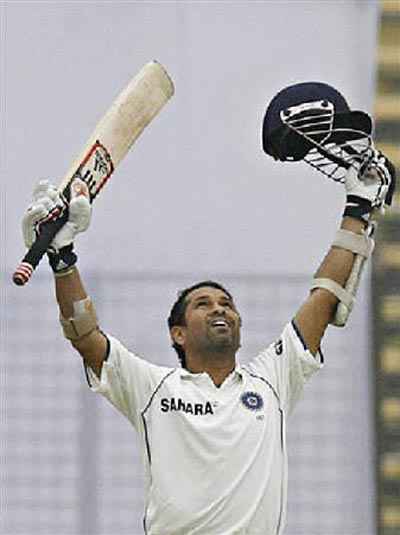 …Well, as it turned out, not only did Sachin successfully save the first Test for India, but he managed to use the occasion to add one more century to his towering stockpile of 87 international centuries – as an afterthought. Does the man have no mercy? Any more moot centuries and the skyscraper might topple over and damage the wicket!
 The last day of the first Test between India and Sri Lanka saw India needing to bat the day out for a draw, with 8 wickets in hand. Mishra – night-watchman for namesake – had just succumbed to a sharp cutter from Matthews. Enter the Maestro.
He looked busy from the start, cutting Matthews to the point boundary and driving Muralitharan against the turn with experienced ease. Building a solid partnership with fellow centurion Gambhir, Tendulkar inched his way closer to his 43rd Test century. Then with VVS Laxman, he carried his bat through till stumps, on the stroke of which he scored his hundredth run of the innings. He also crossed the 30,000 mark somewhere along the line. It was refreshing to see Dhoni and Sangakkara allow Tendulkar the century before calling off the match as a desultory draw.
Give Tendulkar a rampant Aussie team and 50,000 clamouring fans in Sharjah and he will give you a hundred. Give him a dead, even strip such as the one in Kanpur and he would be hard pressed not to score you a century. With Laxman for sedate company, the restful outing he got in the middle seemed the perfect gift from the Cricket Gods to commemorate his strenuous 20 years in international cricket.
What he does not need is the untimely flak he is getting now from Bal Thackeray on what was an absolutely secular comment made by him. Perhaps Thackeray means well. Perhaps he simply wants to use Sachin’s occasion to get some personal leverage. But it is still in bad taste, if you ask me. Even Marathi actors like Atul Kulkarni, Madhur Bhandarkar and Sonali Bendre feel it is a non-issue that is being unnecessarily politicised. Maybe the great man should be allowed to have his achievement untainted.
Meanwhile, Michael Atherton has come out and doused the festivities a bit by drawing attention to the fact that Tendulkar has built his vita opus in the age of helmets and other protective paraphernalia, where the batsman can play without fear of death by leather. He cautions that calling Tendulkar the best ever would be blinding oneself to what the ancient cricketer like Bradman had to negotiate. Sadly this makes it impossible for die-hard cricket enthusiasts to ever declare anyone The Greatest. Technology – ironically something that Tendulkar recently came out denouncing – has struck out at his title. But in Tendulkar’s defence, he has had to contend with something which the great Don did not – bearing the weight of a billion plus hopes upon his spine every time he dons his gloves.
BCCI plans to honour Tendulkar with special mementos during the Annual BCCI Awards Ceremony on December 6. It will be another resonant note in the glorious symphony that is Sachin Tendulkar’s cricket career.
Saturday, November 21, 2009
TWO DOWN. MORE TO GO...?
 Sunil Gavaskar regarded him to be “the closest thing to batting perfection.” Sachin Tendulkar is a human vessel whose every sinew, nerve and neuron impulse was honed to generate the optimal way of meeting a ball with a bat. If Michael Jackson acted as an agent for threading rhythm through the body, Tendulkar has answered nature’s bidding to send billions into quasi-religious frenzy using a combination of wood and leather – for twenty years now.
 When it comes to appraising Tendulkar’s contribution to the game of cricket, the usage of clichés seems unavoidable. For the greater part of two decades, adoring fans and celebrated experts have heaped singular praise on Tendulkar as the Messiah of Cricket, to the point where it sounds hackneyed. “Little Master”, “Master Blaster”, “wiz kid” and “The Master” are epithets that renowned exponents of the game attach to the great man. “Cricket is my religion; Sachin is my God,” runs the phrase on many a fan-made banner in the stadiums.
But while all these titles glorify Tendulkar the artiste, it is Gavaskar’s simple nickname for him that truly reflects the love and adulation an entire nation has for him – “Tendlya.” Rhythmic cries of “Sachin, Sachin” fill the stadium when he is on view. These chants bear the expectations of a country of cricketing fanatics. And perhaps the greatness of Tendulkar lies in how he has remained grounded stolidly on earth despite them. How he has evaded the ever-present risk of letting the constant blandishments go to his head betrays a tad more skill than his ducking of a seething bouncer. Modest to the bone, his feline squeak of a voice retains the innocence of the 16 year-old, while bearing undertones of immense maturity.
However much aficionados set Tendulkar up on a pedestal, many are not blind to the fact that his knocks have not been instrumental in winning India many matches. I grew up with the saying that “if Tendulkar scores a century, India will not win.” Kapil Dev has been known to criticize Sachin for not playing with the team’s cause in mind. Several of Sachin’s great knocks have not forged an Indian victory. The most blaring example of this is the famous “desert storm” innings of 143 against Australia at Sharjah, in 1998, while the 175 versus the same team earlier this month is the latest reflection of the sad phenomenon – in both instances, Tendulkar’s sensational batting failed nevertheless to get India over the line. Kapil Dev recently wrote that he felt disappointed that Sachin had not sustained the ruthless destroyer persona of his first eight years but had turned, instead, into a record breaker along the line.
Then again such criticism is based on sour outlooks. It needs to be pointed out that most of those inningses for which Tendulkar is condemned for not having taken India through have been solo efforts. He has borne the lone torch amid a sea of corpses in a failing batting line up. Even in the recent innings in Hyderabad against the Aussies, his single-handed effort is sidelined by the fact that he did not manage to exert his 36 year-old lungs that bit more to win India a match it deserved to lose.
 An absolutely non-controversial stint as a media specimen has won him the loyalty of his immense fan-base. However, less enamoured Indian supporters are liable to pounce on him in the event of a rare failure. It should be interesting to see reactions should he fail to secure India a draw against Sri Lanka on the final day of the current Test.
Subscribe to:
Posts (Atom)